Rhythmic marks
Lines and dots punctuate the flow.
A new rhythm between marks.
From the artist’s fluorescent handwriting, new forms come into view.
Tap a mark to look closer
Explore the relationship between marks. Each adjustment rearranges the existing glyphs.
Built on the artist’s fluorescent handwriting, Generator explores how the structure of a mark can develop into a new form.
A mark begins with the centre lines of its strokes. These skeletons establish the structure of compact signs and extended, creature-like forms.
The rendering stage follows the skeleton, giving the strokes their width, texture and fluorescent colour.
Lines are refined and stray fragments removed, retaining the dots, eyes and small features that give each form its character.
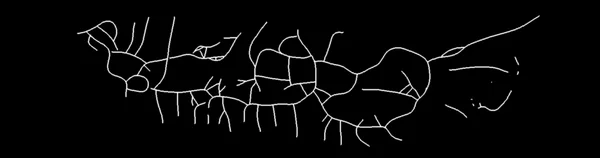
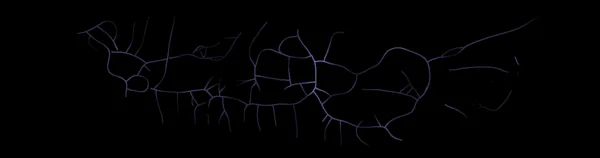
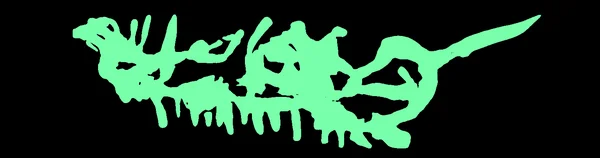
White, blue and green distinguish stages in this process study; they are not the model’s output colours. Model-generated examples, separate from the interactive glyph pool.
Hand-painted marks and generated glyphs are documented separately. Their relationship lies in the evolving practice, rather than a one-to-one pairing.
These marks do not form a language with fixed translations. Their grammar emerges through repetition, intervals, scale and the relationships between forms.
Lines and dots punctuate the flow.
Compact gestures create intervals and shifts.
Extended structures carry movement across a line.
Rhythmic marks, compact signs and extended forms alternate across the wall. Changes in scale and spacing alter the rhythm of a passage. Open “Shape the rhythm” above to explore your own arrangement.
Different aspect ratios are handled by a shared network. Learning the centre lines of strokes allows compact marks and longer creature-like structures to be explored within the same framework.
Kind, length, density and source are represented as separate conditions and combined. They guide visual characteristics, including combinations less common in the existing walls, without assigning fixed meanings to the glyphs.
Skeleton generation and painterly rendering are separate stages. The added skeleton control is zero-initialised so it can gradually learn to follow a supplied structure while developing the stroke appearance.
Rendering is compared on skeletons used during training and on new skeletons, examining stroke overlap, fragments and the main structure. This helps investigate potential memorisation and generalisation issues; it is not a proof of originality. New experimental batches are reviewed separately before publication.
Training material consists only of the artist’s own fluorescent hand-painted work: 8,267 glyphs in the current training dataset. The skeleton model has approximately 72 million parameters. Generated results are not fed back into the training set and remain separate from the hand-painted LO archive.
The glyphs shown here are pre-generated. You can change their arrangement, scale and spacing to explore the same collection in different ways. Layout changes happen in the browser; these interactions do not run the model or generate new glyphs. The project continues to develop.